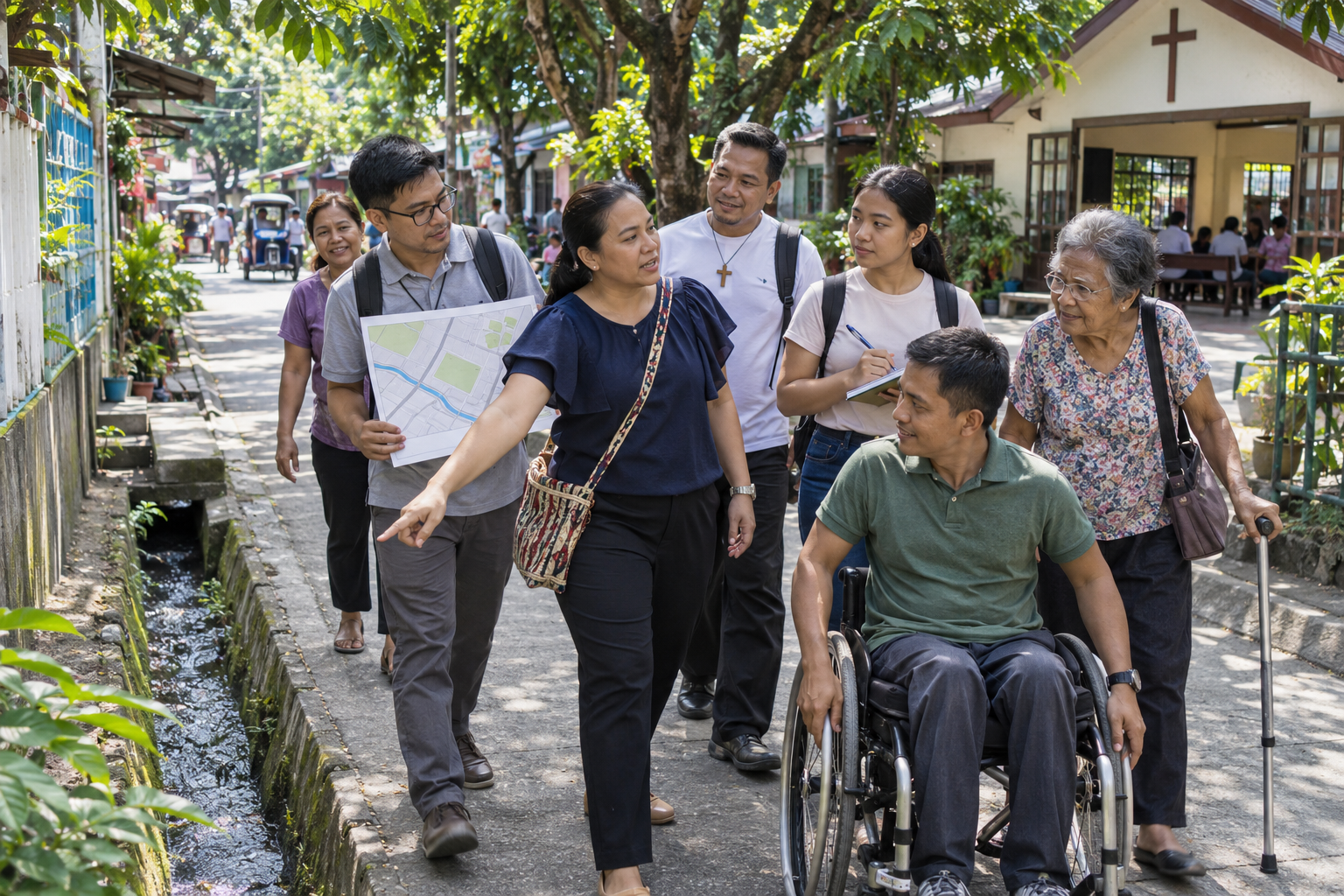
A church can have a loving message and still be difficult to reach. The road may flood. The entrance may have steps but no ramp. Children may cross dangerous traffic. Older people may walk beneath intense heat with nowhere to rest. A resettlement community may have new houses but few jobs, clinics, schools, or transport links. Where people live, travel, gather, and serve shapes whether they can truly participate.
November 8 is Environmental Planning Day in the Philippines and is also observed internationally as World Town Planning Day. The Philippine proclamation establishing the observance connects good planning with safe housing, basic services, environmental protection, balanced use of resources, and a better quality of life. These are not concerns only for government offices or architects. They affect every church that chooses a site, constructs a building, opens a ministry, organizes transport, or serves a growing neighborhood.
The need is urgent. UN-Habitat reports that the Philippines is rapidly urbanizing, with growth spreading beyond Metro Manila into small and intermediate cities. Its recent country-programme update describes pressures involving housing, transport, waste, land tenure, basic services, informal settlements, and climate risk. A new World Bank report released in late October 2026 likewise calls for stronger coordination among local governments so infrastructure, services, skills, markets, and urban growth work together.
Churches and mission teams are not substitutes for licensed environmental planners, engineers, local government, or community organizations. But they make choices with spatial consequences. A responsible ministry learns how a place works, listens to residents, follows land-use and building rules, includes people with disabilities, and partners with qualified professionals before good intentions become avoidable harm.
Mission always happens in a place
Mission is often described through people and programs: evangelism, discipleship, feeding, youth work, prayer, education, medical care, or leadership training. Yet each activity happens somewhere. The place determines who can arrive, who feels safe, how long the journey takes, what it costs, and what risks are created.
A ministry location beside a highway may be visible but dangerous for children. A low-lying site may be inexpensive but repeatedly flood. A second-floor classroom without a lift may exclude a wheelchair user. A crowded event may block a narrow access road needed by an ambulance or fire truck. Loud nighttime worship may damage trust with neighbors who work early or care for a sick family member.
Planning helps a church ask before acting: Who uses this place? Who cannot use it? What happens in heavy rain, extreme heat, fire, earthquake, or power failure? How do people reach home after dark? What services are nearby? What will this project change for surrounding residents?
Listen to the neighborhood before drawing the plan
Communities already carry knowledge that maps may miss. Residents know which path floods first, where traffic moves too fast, when water pressure falls, which corner feels unsafe, and which families struggle to reach public transport. Women, children, persons with disabilities, older people, renters, vendors, drivers, and informal settlers may experience the same street very differently.
Before opening or expanding a ministry, conduct a listening walk with residents and qualified local professionals. Visit at different times and in different weather. Ask people to identify assets as well as problems: shaded routes, active community groups, safe gathering places, reliable water points, local businesses, clinics, schools, and transport connections.
Do not invite residents only after decisions have been made. Participation is not a presentation where leaders explain a finished plan. It means people can influence location, design, schedule, budget, access, and how the ministry will affect their daily lives. Give particular attention to voices that formal meetings often overlook.
Choose land honestly and safely
A cheap or donated property can carry hidden risks: disputed ownership, unclear boundaries, an easement, flood exposure, unstable slopes, protected land, unsafe access, or a land-use classification that does not permit the intended activity. Spiritual enthusiasm does not remove legal or physical reality.
Verify title, zoning, permits, environmental restrictions, hazard information, road access, utilities, and building requirements through the proper government and professional channels. Do not accept a verbal assurance when a written document or technical assessment is required. Keep records and disclose conflicts of interest.
Never pressure a poor family, Indigenous community, tenant, or informal settler to surrender land “for God’s work.” Consent must be free and informed, and compensation must be lawful and fair. A church building gained through intimidation or unequal power contradicts the witness it is meant to carry.
Do not build risk into the ministry
The Philippines faces earthquakes, floods, landslides, typhoons, heat, fire, and other hazards. Good planning does not eliminate every danger, but it avoids placing more people in harm’s way. Use official hazard maps and professional site assessment. Follow the National Building Code, Fire Code, accessibility requirements, local ordinances, and permit processes.
Think beyond the structure itself. Keep emergency access clear. Provide safe exits, lighting, handrails, toilets, drainage, ventilation, water, assembly areas, and signs people can understand. Secure shelves, sound equipment, water tanks, and other heavy objects. Do not expand attendance beyond what the building and evacuation routes can safely hold.
If a church is used as an evacuation center, that role must be coordinated with local authorities and assessed professionally. A building should not be advertised as safe merely because it is large or made of concrete. It needs a plan for water, sanitation, power, privacy, protection, accessibility, registration, and eventual return.
Design accessibility from the beginning
Accessibility is not an optional ramp added after construction. It includes the entire journey: transport, drop-off, path, entrance, doors, seating, platform, toilets, communication, and emergency exit. A steep ramp, narrow doorway, slippery floor, or blocked aisle may satisfy no one in practice.
Walk the route with persons who use wheelchairs, canes, walkers, hearing aids, sign language, or other forms of support. Ask rather than assume. Include older people, pregnant women, parents carrying young children, and people with temporary injuries. Provide seating and shade for those who cannot stand long.
Information should also be accessible. Use clear language, good contrast, readable type, audio where possible, captions, sign-language interpretation when needed, and multiple ways to ask for help. Train ushers to assist respectfully without grabbing a person or moving a mobility device without permission.
Plan for walking, transport, and time
Travel can be the largest hidden cost of participation. A free Bible class may require several jeepney or tricycle rides. A late service may end after safe public transport becomes scarce. A young person may miss schoolwork because the return journey is long. A worker may lose income attending an activity scheduled without regard to shifts.
Map where participants come from and how they travel. Coordinate safe pickup points without blocking roads. Avoid overloading vehicles. Use qualified drivers and roadworthy transport. Share schedules in advance, and end activities when people can still return safely.
Where possible, take smaller programs closer to communities rather than expecting everyone to travel to a central church. Home groups, neighborhood learning spaces, and partnerships with existing local institutions can reduce distance and strengthen local leadership. Confirm that any venue is safe and appropriate before use.
Respect housing and resettlement realities
Moving a family away from a hazard does not automatically create a good life. Resettlement may separate people from jobs, schools, markets, health care, worship communities, and relatives who provide care. Transport costs can rise while income falls. Houses may be completed before water, sanitation, or livelihoods are reliable.
Churches serving resettlement areas should begin with what residents say they need, not with an outsider’s preferred program. Support local congregations, associations, schools, and health services already present. Help connect people with lawful documentation, livelihood services, education, and transport advocacy through qualified partners.
Do not romanticize informal settlements or treat residents as obstacles to city improvement. People may live in risky locations because affordable alternatives, secure tenure, and accessible work are limited. Any relocation or upgrading process should protect dignity, participation, livelihoods, and rights.
Make heat, water, shade, and drainage part of ministry
Environmental planning is visible in ordinary details. Trees and shade reduce heat along walking routes. Good drainage keeps paths usable and limits stagnant water. Permeable surfaces allow rain to soak into the ground. Safe water and sanitation protect health. Waste collection keeps drains from clogging.
PAGASA announced in early November 2026 that a very strong El Niño is present and may persist into 2027, increasing the likelihood of dry spells, drought, water pressure, and warmer temperatures. Churches should conserve water, inspect leaks, plan for safe drinking water, protect outdoor workers, and schedule activities with heat in mind.
Planting trees can help, but choose appropriate native species and consider roots, power lines, sidewalks, visibility, maintenance, and water needs. Do not cover a property entirely with concrete merely for parking. Ask qualified planners and landscape professionals how the site can manage heat and rain while remaining accessible.
Use church property for the common good
A church property can serve the neighborhood beyond worship hours: a shaded waiting area, safe learning room, community meeting place, charging point during emergencies, small garden, or accessible toilet during organized events. Each use needs proper safeguarding, staffing, insurance, maintenance, and agreement with relevant authorities.
Review fences, lights, sound, parking, deliveries, and waste from the neighbor’s perspective. A secure site should not turn the street into a hostile wall. Bright lights should not shine into homes. Vehicles should not block doors or sidewalks. Wastewater should not flow toward another property.
Shared use works best with clear rules. Define hours, responsibility, storage, cleaning, child protection, emergency procedures, and how complaints are handled. Generosity without structure can create conflict; structure without hospitality can make a church feel closed.
Partner with professionals and local government
Environmental planners study how land, housing, transport, infrastructure, economy, environment, and people interact. Architects, engineers, accessibility specialists, health workers, disaster officers, social workers, and community organizers contribute other essential knowledge. Churches should value this expertise rather than asking an unqualified volunteer to sign off on technical decisions.
Build relationships with the barangay, city or municipal planning office, disaster risk reduction and management office, building official, fire service, health office, and community associations. Ask which plans already exist and where public participation is invited. Support residents in joining lawful consultation processes.
Partnership does not mean endorsing every decision without question. Churches can advocate respectfully for safer crossings, better drainage, accessible transport, honest resettlement, green space, clean water, and basic services. Use evidence, protect affected people, avoid partisan manipulation, and keep the focus on the common good.
Plan mission trips around place, not only programs
Short-term teams often prepare sermons, supplies, and schedules but know little about the community’s geography. Before arrival, they should learn how participants travel, which areas are unsafe, where activities are permitted, what weather and hazards are expected, and how their vehicles and crowds may affect residents.
Do not create a large event simply because a visiting team wants visible results. A smaller activity in an appropriate venue may serve people better. Use local coordinators, follow capacity limits, provide accessible seating and toilets, manage traffic, and leave the site cleaner than it was found.
Foreign partners should not promise construction, land, housing, or infrastructure before technical and legal review. Photographs of unfinished facilities can attract donations, but fundraising should never outrun planning, permits, community consent, or a realistic maintenance budget.
Ask better questions before saying yes
Before a church builds or starts a place-based ministry, leaders can ask: Is the location lawful and safe? Who owns the land? Who can reach it? Who is excluded? What happens during heavy rain, heat, fire, earthquake, or power failure? Are water, toilets, ventilation, drainage, and emergency access adequate? How will neighbors be affected? Who will maintain the site after the launch?
Write the answers and name unresolved risks. Set aside money for professional advice, permits, maintenance, accessibility, and safety rather than spending the entire budget on visible construction. Invite independent review when leaders have a personal or financial interest in the decision.
Good planning may slow a project, change its design, or reveal that a different location is wiser. That is not a failure of faith. It is stewardship—choosing long-term service over the excitement of beginning quickly.
A city where neighbors can flourish
Jeremiah’s call to seek the welfare of the city invites believers to care about the systems and spaces that shape a neighbor’s life. The church’s concern should reach the crowded road, the flooded path, the inaccessible entrance, the distant resettlement site, the overheated classroom, and the family unable to afford the journey.
Environmental Planning Day reminds us that a livable community does not appear by accident. It grows through honest land decisions, professional knowledge, public participation, responsible government, and neighbors willing to think beyond their own property line.
Mission that understands place becomes more attentive and more faithful. It does not merely invite people into a building. It helps build communities where children can walk safely, persons with disabilities can participate, families can access services, creation is respected, and every neighbor has room to belong.
Further reading: the Philippine proclamation establishing Environmental Planning Day; UN-Habitat’s Philippine guide to climate-resilient urban planning; the World Bank’s October 2026 report, From Cities to Corridors; and PAGASA’s November 2026 advisory on the very strong El Niño.
Plan ministry for every neighbor
Ask SendUsAll about responsible mission preparation, locally led partnership, and practical service in the Philippines.
Contact SendUsAll