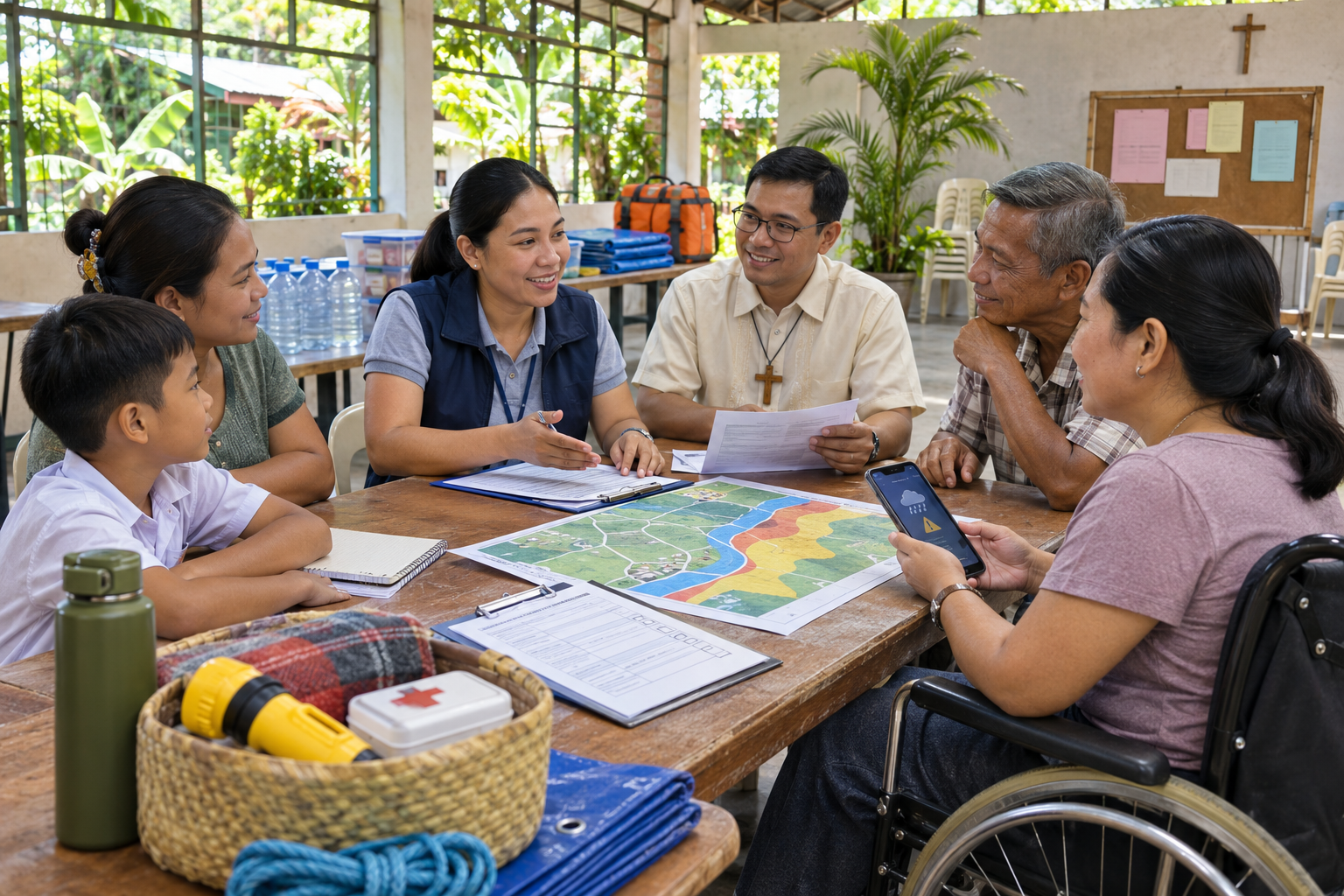
A storm can pass while hardship is only beginning. A fisher may lose days of income even when the boat survives. A mother may spend the family’s food money on transport to an evacuation center. A farmer may endure months of drought rather than one dramatic day. An older person may miss medicine because prices rise. When a climate shock meets a household already living close to the edge, the emergency is not only wind, rain, or heat—it is the loss of choices.
On November 9, PAGASA reported that Typhoon Samuel had exited the Philippine Area of Responsibility, while warning that monsoon winds would still affect much of Luzon and the Visayas. At the same time, a recent United Nations snapshot says the Philippines is preparing for a very strong El Niño, with expected pressure on crops, water, health, food access, prices, and livelihoods into 2027. Fast emergencies and slow emergencies can overlap.
This week, governments and partners are meeting in Bangkok for a regional dialogue on Climate Resilient and Inclusive Social Protection. The discussion is about a crucial shift: helping people before a shock becomes a humanitarian crisis, using systems that can protect income, food, health, disability support, livelihoods, and dignity.
Churches and mission teams are not social welfare departments. They cannot replace government, professional casework, public financing, or legal entitlements. But they are close to households. They hear about a lost job, a missing document, a damaged roof, an older person living alone, or a family that never received an alert. That nearness can help the public safety net reach people it might otherwise miss.
What social protection actually means
Social protection includes public policies and programs that help people manage risks across life: child and family benefits, health protection, disability benefits, pensions, unemployment support, maternity protection, livelihood assistance, school feeding, and emergency cash or in-kind aid. It is not simply relief after a disaster. A strong system helps people prepare, absorb a shock, recover, and avoid being pushed deeper into poverty.
In much of Southeast Asia, many workers earn through farming, fishing, vending, construction, transport, domestic work, tourism, or other informal jobs. They may not have paid leave, unemployment insurance, stable wages, or complete records. ESCAP notes that informal employment and fragmented administration leave many people outside contributory schemes, while tightly targeted programs can also miss families who are poor or close to poverty.
A family does not need to be officially classified among the poorest to be vulnerable. One hospitalization, crop failure, school expense, fuel increase, or week without work can push a near-poor household into debt. UNICEF and the Philippine Department of Social Welfare and Development highlighted this concern in a March 2026 study of near-poor households and gaps in coverage.
Climate risk is also an income risk
Church disaster plans often focus on evacuation, relief packs, and cleanup. These are necessary, but the financial effects continue after visible damage is gone. Heat can reduce construction hours. Haze can stop outdoor work. Drought can shrink harvests and raise food prices. Flooded roads can prevent a market vendor from trading. A school closure can force a parent to stay home. Repeated small losses can be as damaging as one major disaster.
Climate policy can also affect livelihoods. New regulations, changing energy systems, fishing restrictions, or relocation from high-risk areas may serve an important public purpose while creating transition costs for workers. A just response asks who bears those costs and whether affected people receive training, income support, consultation, and realistic alternatives.
Mission teams should therefore avoid describing resilience only as personal toughness. Families may be resourceful and faithful yet still need functioning public systems, fair work, accessible services, secure documents, and timely assistance. Resilience is strengthened when responsibility is shared.
Act before the forecast becomes loss
Anticipatory action uses credible forecasts and agreed triggers to release help before the worst impact. That may mean early cash, transport assistance, livestock protection, water storage, prepositioned supplies, or communication designed for people with disabilities. Acting early gives families more choices than arriving after assets have been sold or debts taken on.
In October 2026, the Philippine Pantawid Pamilyang Pilipino Program shared lessons from using existing 4Ps information, payment, communication, and case-management systems for anticipatory action. One example involved assistance delivered to more than 42,000 households before Super Typhoon Fung-Wong in 2025. The important idea is not simply “send money earlier.” It is to use reliable risk information and established systems to identify, inform, reach, and support families before a crisis escalates.
A church can complement this work by checking whether alerts reached people, helping residents understand official instructions, identifying lawful transport options, and referring urgent protection concerns. It should not create its own unofficial beneficiary list and promise public assistance. Government eligibility and enrollment must follow proper procedures.
Help people reach the system
Access barriers are often ordinary: a missing birth certificate, an expired identification card, a changed mobile number, an inaccessible office, a form in an unfamiliar language, transport cost, lack of internet, or fear of being treated badly. Migrant workers, displaced people, renters, informal settlers, Indigenous communities, older adults, and persons with disabilities may face additional barriers.
Churches can host an information session led by authorized local officials or accredited organizations. They can offer a safe place to complete forms, make photocopies, access the internet, or learn which office handles a concern. Volunteers can explain publicly available steps without claiming to be government representatives.
Never collect identity documents casually. If a ministry helps with an application, define what data is needed, who may see it, where it is stored, and when copies are destroyed. Do not photograph benefit cards or post a recipient’s name online. The desire to demonstrate impact does not cancel privacy.
Include people who are usually missed
A preparedness meeting held upstairs may exclude a wheelchair user. A text alert may miss someone with low literacy. A cash program may be inaccessible to a person without a phone or bank account. An evacuation plan may overlook a caregiver who cannot leave a bedridden relative. Inclusion requires design, not good intentions.
Map the whole journey: receiving an alert, reaching an office, presenting documents, receiving assistance, using it safely, and appealing a decision. Invite persons with disabilities and caregivers to identify obstacles. Provide seating, accessible toilets, clear language, sign-language support where needed, and more than one communication channel.
Do not assume that the household head is the only person who needs information. Women may manage food, care, medicine, and school expenses while having limited control over cash. Children may face interrupted learning or protection risks. Older people may prioritize medicine and transport. Assistance works better when the different responsibilities inside a household are understood.
Protect dignity in every assessment
Churches sometimes ask families to repeat painful stories to several committees before receiving help. They may require public testimony, photographs, or attendance at a service. These practices can turn assistance into humiliation. Need should be assessed fairly, privately, and with the minimum information required.
Never condition relief on conversion, baptism, church membership, political support, or public gratitude. Christian service is not a transaction. People of any faith or none should receive assistance according to transparent criteria and available resources.
Explain what the ministry can and cannot provide. Avoid promising money before funds are secured. Create a simple complaints and appeals process. Separate those approving assistance from those handling cash where possible, keep records, and disclose conflicts of interest. Accountability protects both families and the church.
Use cash carefully and appropriately
Cash assistance can preserve choice and support local markets when goods are available and prices are reasonably stable. It may allow one family to buy medicine, another to pay transport, and another to repair fishing equipment. But cash is not automatically the best response in every setting.
Before starting a cash program, assess market conditions, safety, financial access, fraud risk, household dynamics, data protection, and coordination with government and humanitarian partners. Avoid duplicating assistance while another community is overlooked. Use secure payment methods and never publish recipient lists.
Churches with limited capacity may serve better by contributing to an established program, funding transport, providing communication support, or helping with referrals. A small ministry should not build a complicated payment system that it cannot safeguard or audit.
Connect relief to livelihoods and care
A family may need food today and a way to earn next month. Recovery support can include replacing essential tools, restoring a small business, linking farmers to agricultural advice, arranging child care during training, or helping workers access lawful job services. Support should be based on local demand and realistic markets, not on whatever training an outside team happens to offer.
Care responsibilities also affect recovery. A livelihood program may fail if a mother cannot leave a young child, a person with disability lacks transport, or an older caregiver cannot attend a distant meeting. Flexible schedules, accessible venues, child safeguarding, and transport support are not extras; they determine who can participate.
Refer specialized needs. Survivors of violence, children at risk, people with severe mental distress, and households facing eviction or trafficking need qualified services and confidential case management. A pastor can offer spiritual care while respecting professional boundaries.
Prepare for slow-onset emergencies
Very strong El Niño conditions may unfold through reduced rainfall, water stress, crop loss, food-price pressure, and heat. There may be no single day that everyone recognizes as the disaster. Churches should watch official seasonal advisories and listen for early household signals: farmers borrowing for food, children missing school, workers skipping medicine, wells failing, or meals becoming smaller.
Coordinate with the barangay, agriculture office, health workers, water providers, schools, and social welfare office. Promote safe water conservation, heat protection, nutrition, and lawful livelihood assistance. Avoid unverified seed distributions, unsafe water systems, or technical promises without professional review.
Build a reserve before need peaks. Agree in advance how emergency funds may be released, who authorizes them, what records are required, and how decisions will be reviewed. Prepared governance is part of compassionate ministry.
Support migrant and displaced families
Climate stress often interacts with migration. A rural worker may move to a city after crop loss. A coastal family may relocate repeatedly. A migrant worker may lose housing and employment at the same time. Assistance tied strictly to one residence or formal job can leave mobile families outside the system.
The International Labour Organization has urged governments and practitioners to extend social protection to migrant workers, refugees, and displaced people in the context of climate change. Churches serving mobile communities can help with accurate information, documentation referrals, language support, safe shelter pathways, and connection to local congregations without pressuring people to remain dependent on the ministry.
Protect location and identity information, especially when a person fears trafficking, violence, detention, or retaliation. Never publish a displaced family’s photograph or story without informed consent and a careful risk assessment.
Coordinate instead of creating a parallel system
A church may know its members well, but a public system must serve a wider community. Parallel lists, separate assessments, and uncoordinated distributions can create duplication, jealousy, and gaps. Before launching assistance, ask what the local government, schools, health centers, other churches, and humanitarian organizations are already doing.
Partnership does not require silence about problems. Churches can respectfully report exclusion, inaccessible services, delayed assistance, corruption, or unsafe conditions. Document patterns without exposing individuals. Advocate for transparent criteria and accessible appeals rather than asking for favors for preferred families.
Local leadership should shape the response. Outside mission teams can bring funds or skills, but they should not control beneficiary selection from a short visit. Decisions must be grounded in local knowledge, professional standards, and accountable systems.
A practical church checklist
Begin by identifying official contacts for social welfare, health, disaster management, disability affairs, agriculture, and child protection. Keep the list current. Learn the main public programs in the area and the proper referral routes. Train a small volunteer team in safeguarding, confidentiality, fraud prevention, and respectful communication.
Ask who is not being reached. Check older people living alone, persons with disabilities, informal workers, migrant families, remote households, caregivers, and people without digital access. Do not assume that the loudest request represents the greatest need.
Finally, rehearse. Test the phone tree, accessible transport plan, emergency fund process, data safeguards, and coordination contacts before the next warning. A system that exists only on paper may fail when the power is out and roads are blocked.
Mercy that arrives in time
The Good Samaritan did not merely feel concern. He crossed the road, treated wounds, arranged transport, paid for continuing care, and promised follow-up. His compassion connected immediate help with a path toward recovery.
Climate-resilient social protection asks communities to practice that same kind of timely, organized care at a larger scale. It recognizes that a family should not have to lose everything before becoming visible. Assistance can arrive before the roof is gone, before the debt becomes impossible, before a child leaves school, and before a preventable shock becomes a long crisis.
Churches serve best when they are neither spectators nor substitute governments. They are trusted neighbors who listen, protect dignity, connect people to lawful support, strengthen local systems, and remain present after attention moves elsewhere. That is mission shaped by mercy—and mercy prepared to arrive on time.
Further reading: ESCAP’s November 2026 Climate Resilient and Inclusive Social Protection dialogue; the United Nations Philippines El Niño impact and response snapshot; DSWD’s account of using 4Ps systems for anticipatory action; UNICEF and DSWD’s study of near-poor households and social protection; and ILO guidance on extending protection to migrant and displaced populations.
Help families prepare with dignity
Ask SendUsAll about locally led mission preparation, responsible partnership, and practical service in the Philippines.
Contact SendUsAll