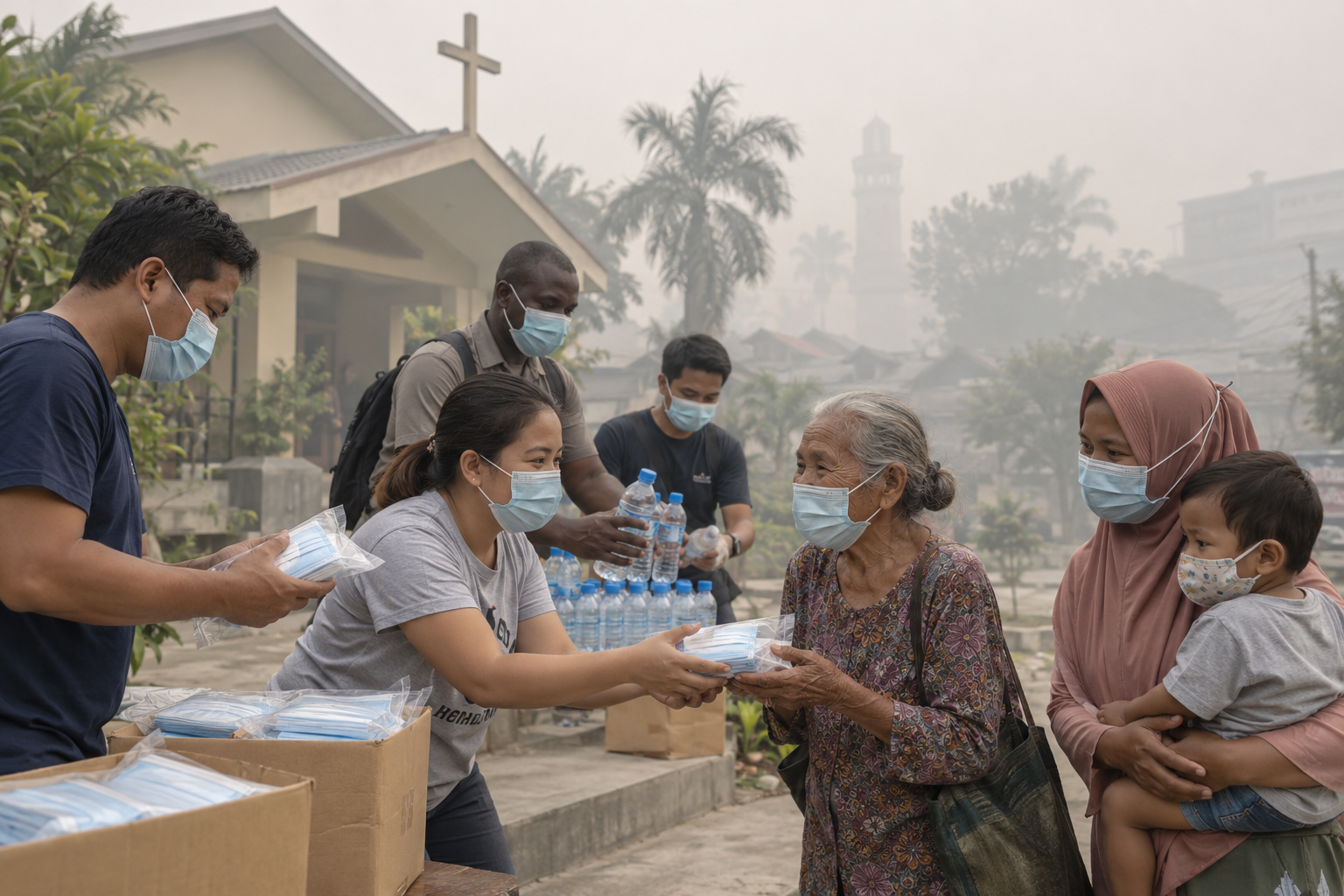
A thick haze is spreading across parts of Southeast Asia, turning familiar skylines gray and making ordinary breathing dangerous. Forest and peatland fires in Indonesia have sent smoke across borders into Malaysia, Singapore, Timor-Leste, and as far as the Philippines. This is not only an environmental story. It is a human crisis—and therefore a mission concern.
The haze has become one of the region's most searched and discussed issues this month. On October 15, Reuters reported that more than 283,000 cases of respiratory illness linked to the fires had been recorded in seven Indonesian provinces. Schools have closed, flights have been delayed, and many families have been told to reduce time outdoors. The ASEAN Intergovernmental Commission on Human Rights has also described clean and healthy air as a basic right and called for urgent regional action.
Governments, firefighters, health workers, and environmental agencies carry major responsibility for dealing with the crisis. Churches cannot replace them. But local congregations are already present in neighborhoods, villages, schools, and cities. They know older people who live alone, children with health problems, families who cannot afford protective supplies, and workers who must remain outdoors. This means the Church can respond quickly with practical love.
Begin with accurate information
During any crisis, rumors can spread faster than reliable guidance. Churches should share information only from public-health authorities, local governments, and trusted emergency organizations. Leaders should check the date and location of every advisory before forwarding it. Air quality may be dangerous in one city while conditions are different somewhere else.
Congregations can help members understand official air-quality alerts, school announcements, transport changes, and local health instructions. Messages should be short, clear, and translated into the language people understand best. If a church does not know whether a claim is true, it should wait and verify rather than increase fear.
Pastors should also avoid presenting themselves as medical experts. Anyone who experiences breathing difficulty, chest pain, severe coughing, confusion, or another serious symptom should seek professional medical help. Prayer is important, but prayer and responsible medical care should not be treated as enemies.
Protect the most vulnerable
Haze does not affect everyone equally. Children, older adults, pregnant women, people with heart or lung conditions, outdoor workers, and low-income families may face greater difficulty. Some people can stay inside an air-conditioned building, buy quality masks, or travel to a cleaner area. Others cannot.
A local church can create a simple list of vulnerable members and neighbors, then contact them regularly. Volunteers may help deliver food, medicine, clean water, or protective masks where public-health authorities recommend them. Churches with safer indoor facilities may coordinate with local officials before opening a temporary clean-air room or rest space. Any such response should follow official guidance and avoid crowding people into an unsafe building.
Churches should not distribute poor-quality supplies simply to appear active. It is better to provide fewer suitable items than many products that give false confidence. Ministry teams should learn how to use protective equipment properly and explain that masks are only one part of staying safe.
Care for people whose work is disrupted
The haze affects livelihoods as well as health. Drivers may lose passengers. Outdoor vendors may have fewer customers. Construction workers, farmers, delivery riders, and other laborers may face the painful choice between breathing dangerous air and losing daily income. Flight cancellations and school closures also create extra costs for families.
Church benevolence funds can provide temporary food assistance or transportation support for families under pressure. Congregations can buy supplies from affected small businesses when it is safe to do so. Employers in the church can review work schedules, offer indoor duties, provide proper protection, and avoid forcing workers to remain outside during hazardous conditions.
This is an important part of holistic mission. The Gospel speaks to the whole person. We proclaim salvation in Jesus Christ while also caring about whether a family can breathe, eat, work safely, and protect its children.
Support responders without creating more risk
Firefighters, health workers, community leaders, and volunteers are serving under difficult conditions. Churches can pray for them, provide meals or supplies through approved channels, and share verified calls for assistance. However, untrained mission teams should not enter active fire zones or travel into dangerous areas simply because they want to help.
Good intentions do not remove risk. Uncoordinated volunteers can become additional people who need rescue. The safest and most useful approach is to ask local authorities or established humanitarian organizations what help is actually needed. Churches should respect road closures, evacuation instructions, and professional safety decisions.
Financial gifts should also be handled carefully. Use trusted organizations, keep clear records, and report how donations were used. Crisis should never become an opportunity for dishonest fundraising or publicity.
Creation care is part of Christian witness
The current haze is connected to forest and peatland fires made worse by long dry conditions and harmful land-clearing practices. The smoke crosses national borders, showing how closely the people and ecosystems of Southeast Asia are connected. What happens to a forest in one country can affect the lungs of a child in another.
Christians believe that the earth belongs to God. Caring for creation does not replace evangelism; it demonstrates obedience to the Creator and love for our neighbor. Churches can teach against destructive burning, careless waste, and business practices that value profit more than human life. They can support responsible farming, tree restoration, local clean-up efforts, and honest public discussion about environmental responsibility.
Missionaries should also examine their own events and ministries. Are we creating unnecessary waste? Do our projects respect local land and water? Are we listening to communities that suffer the consequences of environmental damage? A mission that speaks about God's love should not ignore the condition of God's world.
Pray across borders
Transboundary haze reminds the Church that compassion must also cross borders. Filipino Christians can pray for Indonesian firefighters and families. Churches in Singapore and Malaysia can support affected communities without speaking with anger or prejudice. Indonesian believers can advocate for accountability while also serving neighbors near the fires.
Prayer can include government leaders, environmental agencies, health workers, school officials, farmers, business owners, children, older people, and everyone experiencing illness or financial loss. We can ask God for rain, wisdom, courage, justice, and cooperation among nations.
The Church is called to be present when life becomes difficult. During the haze crisis, this presence may look simple: a verified message, a phone call to an older neighbor, a suitable mask, a food package, a safe ride to a clinic, or prayer offered with compassion. These actions may seem small, but together they show a Gospel that can be seen as well as heard.
Further reading: Reuters' October 15 explanation of the haze crisis and the ASEAN human-rights statement on transboundary haze. Follow current instructions from your local health authority.
Serve communities with us
Pray with SendUsAll, support practical compassion ministry, or ask how your mission team can serve responsibly alongside local churches in the Philippines.
Contact SendUsAll