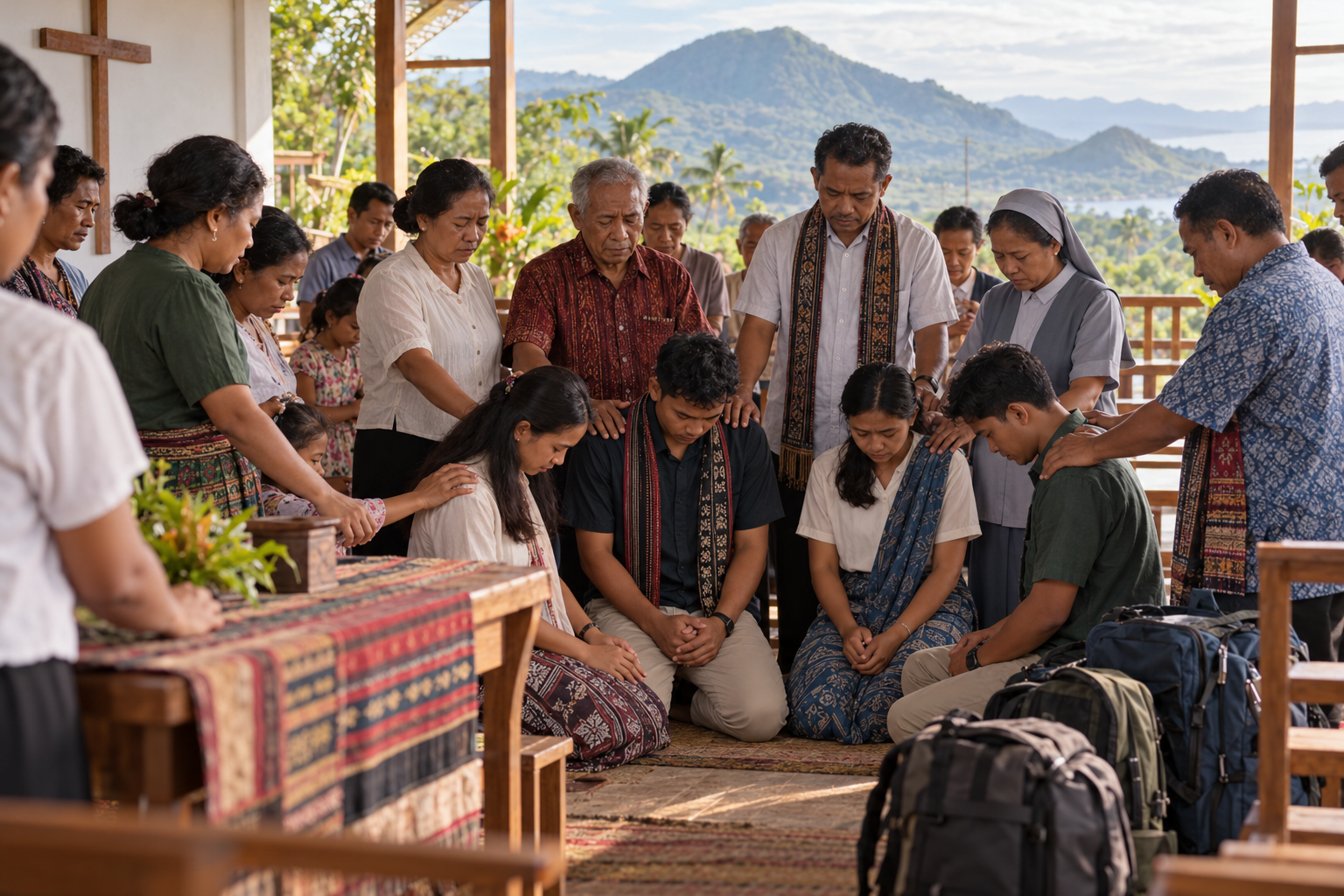
For generations, Southeast Asia has often been described as a place that receives missionaries. Flores, a mountainous island in eastern Indonesia, tells another part of the story. Its churches are not only receiving the Gospel. They are forming and sending men and women to serve communities across Indonesia and far beyond Asia.
Fresh international attention has called Flores Indonesia's “priest island.” The title points to an unusual concentration of seminaries, religious communities, and missionary vocations in a country where Christians are a minority. Church reports published in October 2026 say around one thousand priests and religious women from Flores are now serving in missions and communities around the world, including more than three hundred from the Diocese of Larantuka.
Numbers do not tell the whole story, and one Christian tradition does not represent every church. Yet Flores offers a valuable lesson for Catholic, Protestant, Pentecostal, and independent believers alike: mission now moves from everywhere to everywhere. The churches of Africa, Asia, Latin America, and the Pacific are not waiting at the edge of someone else's mission map. They are praying, forming, sending, receiving, and leading.
Mission grows from faith practiced at home
Church leaders in Flores repeatedly point to family life as the cradle of missionary vocation. Children see parents and grandparents pray, worship, practice charity, and serve their neighbors. Calling is not introduced only during a large conference. It grows through years of ordinary faith.
This does not mean every faithful family will send a full-time missionary. It means children learn that following Jesus includes giving their lives in service. A home can nurture mission when parents pray for nations, welcome people from different cultures, speak respectfully about other communities, give generously, and let children see ministry as joyful obedience rather than punishment.
Churches can strengthen this foundation by helping families discuss calling without pressure. Young people need room to ask questions, explore gifts, receive education, and mature. Adults should not use spiritual language to force a child into ministry or treat another career as less holy. A genuine call must be discerned with freedom, wisdom, and time.
Formation is deeper than enthusiasm
Flores is known for seminaries and houses of formation. Whatever structure a church uses, the principle matters: desire to serve must be joined with patient preparation. Prayer, Scripture, character, theological understanding, practical ministry, and community life shape a person before a passport or platform does.
Cross-cultural workers also need language learning, cultural listening, safeguarding, teamwork, financial accountability, conflict resolution, and emotional maturity. A person may feel called to another nation but still be unready to work under local leadership, manage stress, or live respectfully in a different culture.
Preparation should include supervised service close to home. Can the future missionary teach children safely, visit the sick, keep confidential information private, work with a team, receive correction, and finish ordinary tasks? Faithfulness in a local congregation often reveals more than success on a short, exciting trip.
The sending church remains part of the mission
A commissioning prayer is not a farewell to responsibility. When a church lays hands on a missionary, it accepts a continuing relationship. The church should pray, communicate, provide pastoral care, review finances, help solve problems, and welcome honest reports that include difficulty as well as victory.
Missionaries sometimes feel that supporters only want dramatic testimonies. This can make them hide loneliness, team conflict, culture shock, family strain, or ministry disappointment. A healthy sending church asks more than, “How many people came?” It also asks, “How is your soul? How is your family? Are local leaders able to speak honestly with you? What support do you need?”
Care must include children and spouses. Missionary children experience real losses even when they enjoy their new home. Spouses may carry unseen ministry, employment, or caregiving burdens. Single missionaries also need friendship, boundaries, rest, and community. No one becomes less human by answering God's call.
Women are central to the sending movement
The Flores story is sometimes told mainly through the number of priests, but religious women and laywomen are also serving locally and across borders. Recent reports describe Indonesian sisters caring for survivors of abuse, supporting young people, strengthening families, and working for the dignity of women and children.
Churches should recognize, train, protect, and support women in mission without reducing their service to invisible assistance. Women bring leadership, theological insight, pastoral care, professional skills, community knowledge, and access to spaces men may not enter. Their voices should be present when ministries set priorities, budgets, safeguarding policies, and evaluation standards.
Honoring women also means refusing ministry cultures that excuse harassment, exploitation, or spiritual control. Clear reporting systems, screened leaders, safe accommodation, financial transparency, and serious responses to misconduct are part of missionary faithfulness.
Strong local roots prepare people to cross cultures
A missionary does not become useful by rejecting their home culture. Flores missionaries carry the memory of island communities, extended families, shared prayer, hospitality, local music, and resilience. African missionaries carry their own gifts. Filipino missionaries carry theirs. These backgrounds can enrich the global church.
At the same time, no culture is the Gospel. Missionaries must learn which habits are biblical convictions and which are familiar preferences. A worship style, leadership title, meal schedule, clothing choice, or communication pattern that feels normal at home may not serve another community well.
Cultural humility begins with listening. Learn people's names correctly. Study language seriously. Ask local pastors what has already been tried. Notice how respect, disagreement, hospitality, time, and family decisions work in the community. Do not treat local believers as assistants to an imported plan.
Receiving churches are leaders, not destinations
The image of mission as a straight line—from a strong sending church to a needy receiving church—is too simple. A church may send workers in one season and receive them in another. A Filipino congregation may welcome an African missionary while supporting a Filipino worker in Thailand. An Indonesian missionary may serve in Europe while learning from a local migrant church. Everyone has gifts to give and lessons to receive.
Receiving churches should help define the work. They understand language, law, history, community relationships, and religious sensitivities. They should have authority to correct missionaries, protect local people, and say no to activities that could cause harm. Partnership is not real if decisions remain with whoever controls the money.
Missionaries must also resist building ministries around their own personality. The goal is not to remain permanently necessary. Healthy service strengthens local leaders, shares knowledge, builds accountable teams, and prepares for leadership transition.
Service at home and abroad belongs together
Flores's missionary identity exists alongside local needs. In 2026, communities on the island faced a powerful earthquake. Churches, universities, religious communities, families, and neighbors responded through solidarity and practical presence. Mission beyond the island did not remove responsibility for people nearby.
Jesus sends the church across streets as well as seas. A congregation that speaks about distant nations while ignoring violence, poverty, disaster, loneliness, or injustice in its own community has separated what God joined together. Local compassion trains future missionaries to recognize human dignity wherever they go.
Holistic mission may include evangelism, discipleship, education, health care, disaster response, peacebuilding, protection of children, and support for families. These actions do not replace the Gospel. They show that the good news of Jesus concerns whole people and real communities.
Vocations are people, not a supply chain
International discussion about Flores sometimes focuses on shortages of priests or Christian workers elsewhere. Churches must be careful not to speak as if young Indonesians are a labor supply for institutions in wealthier countries. Every missionary is a person with a family, culture, calling, limitations, and right to proper care.
Receiving organizations should provide fair support, lawful immigration arrangements, language training, safe housing, rest, health care, and clear accountability. They should not use spiritual obedience to silence concerns or keep workers in harmful conditions. Missionary sacrifice is never permission for exploitation.
Sending leaders must also ask whether an overseas placement fits the person's gifts and calling, not only whether an opening exists. Careful matching, orientation, supervision, and regular review help workers serve well and return home healthy.
Resilience needs community, not heroic exhaustion
Island communities know that resilience is not only personal strength. It is built through relationships, shared resources, prayer, memory, and presence. The same is true for mission. A worker who appears strong can still become exhausted when support is weak.
Churches should normalize rest, medical care, counseling, spiritual direction, and honest debriefing. Missionaries need permission to pause, change an assignment, or return home without shame. Long service is not automatically healthy service, and burnout is not proof of greater devotion.
Prayer remains central, but prayer should not be used to avoid practical responsibility. The church that prays for protection should also create safeguarding systems. The church that prays for provision should budget carefully. The church that prays for fruit should provide training and accountability.
Southeast Asia is a sending region
Flores challenges an old mission map. Christianity's global story is no longer centered in one continent sending to the rest. Indonesian, Filipino, Korean, Singaporean, Malaysian, Thai, Myanmar, African, Latin American, Pacific, European, and North American believers now meet one another as both senders and receivers.
This movement should not create a new competition over which nation sends the most workers. The goal is shared obedience. Churches can exchange teachers, pastors, youth leaders, counselors, relief specialists, church planters, and intercessors while remaining accountable to local leadership.
The deeper lesson from Flores is not simply that an island produces many missionaries. It is that faith can take root in families, be formed in community, survive hardship, and become a gift beyond its place of origin. When local churches nurture calling carefully and send with humility, Southeast Asia does not stand at the edge of the Great Commission. It helps carry the Gospel to the nations.
Further reading: Fides News Agency's October 2, 2026 report on Flores's global missionary vocations, its feature on faith and formation in Ruteng, and Vatican News on the Diocese of Ruteng.
Help the church send with wisdom
Pray with SendUsAll, support cross-cultural workers, or ask how your church can build a responsible mission partnership in Southeast Asia.
Contact SendUsAll