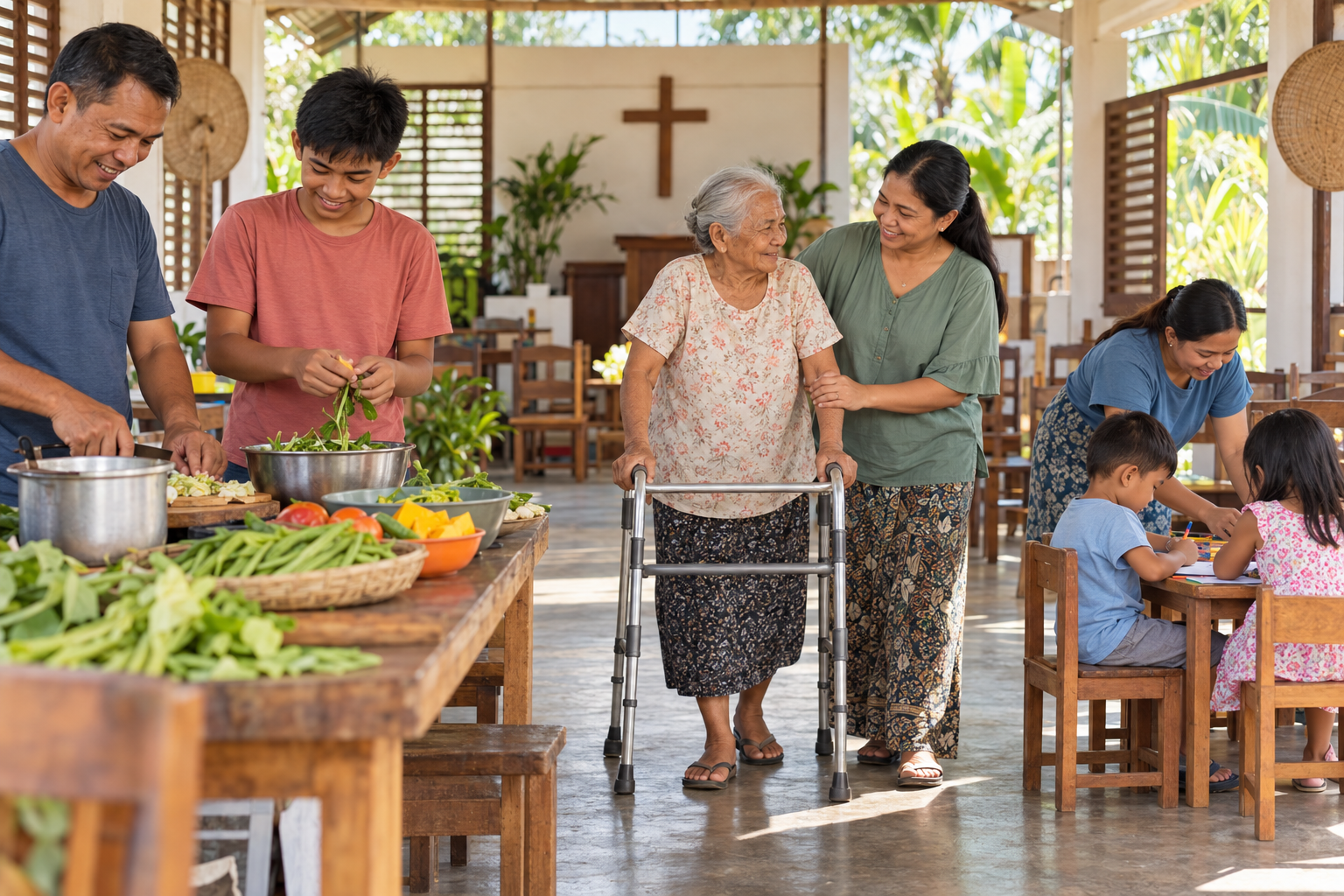
Before a worship service begins, someone has already prepared food, dressed the children, checked an older relative's medicine, cleaned the room, answered messages, and made sure everyone can arrive. This work is easy to overlook because it often happens quietly. Yet families, churches, workplaces, and mission teams cannot function without care.
Care has become a major regional conversation. The ASEAN Conference on Investing in Care opens in Metro Manila on October 28, 2026. The gathering is expected to launch new regional guidance for strengthening the care economy. That phrase includes both paid and unpaid work that supports children, older people, people with disabilities, sick relatives, households, and communities.
This matters deeply to Christian mission. Churches depend on care every day, but they can also repeat unfair patterns. Women and girls are often expected to cook, clean, watch children, visit the sick, organize hospitality, and support ministry leaders without rest, pay, training, or public thanks. When this work is treated as endless and automatic, caregivers become exhausted and their own callings may be pushed aside.
Care is real work
Care is sometimes described as love rather than work. It is certainly an expression of love, but love still requires time, skill, strength, and resources. Preparing safe food, helping someone bathe, supervising a child, accompanying an older person to a clinic, or staying awake with a sick relative can be physically and emotionally demanding.
The ASEAN Magazine reports that women and girls across Asia and the Pacific spend two to five times more time on unpaid care and domestic work than men. In Viet Nam, for example, women spend close to 19 hours a week on unpaid care compared with about eight hours for men. The same regional pattern limits women's opportunities to study, earn income, rest, lead, and participate fully in community life.
Recognizing care as work does not make families cold or commercial. It helps us tell the truth about what holds a household together. A church that sees this work can respond with gratitude, practical support, and fairer sharing.
Look for the hidden load in church life
Churches should examine who performs the tasks behind every ministry. Who buys supplies, prepares meals, cleans after the event, supervises children, cares for visiting speakers, and follows up with sick members? Who is expected to serve because they are a woman, a pastor's spouse, unmarried, young, or not in formal employment?
A simple ministry review can reveal an unequal load. List each recurring task, how long it takes, who does it, what training it requires, and whether the person has freely agreed. Include invisible duties such as planning, remembering birthdays, arranging transport, or answering late-night messages. Then ask whether responsibilities can be rotated, reduced, combined, or supported with a budget.
Do not assume that a person who does not receive wages has unlimited time. Home-based work, parenting, elder care, study, and informal livelihood all place real demands on a week. Volunteers need clear hours and permission to say no without guilt.
Share care across women and men
Jesus welcomed children, touched people others avoided, fed crowds, listened to those in pain, and washed his disciples' feet. Care is Christian discipleship, not a role reserved for one gender. Men and boys can cook, clean, comfort children, visit older members, and learn practical caregiving skills. Women should not have to carry the whole load before they are allowed to preach, lead, study, or rest.
Church leaders can model this change publicly and quietly. A male pastor can help prepare food or supervise children without making the act a performance. Fathers can arrange their work and ministry schedules around family responsibilities. Youth groups can teach every participant basic household and caregiving skills.
Shared care also protects marriages and ministry families. When one spouse is always available to the congregation and the other absorbs every need at home, resentment and exhaustion can grow. A healthy mission calling includes honest agreement about time, travel, children, finances, rest, and emergencies.
Build churches where caregivers can belong
Caregivers may miss worship because buildings, schedules, and programs do not fit their realities. An older person may need accessible transport. A parent may avoid church because there is no safe place to feed or calm a child. Someone caring for a relative with dementia may be unable to sit through a long service.
Small changes can open the door: accessible entrances and toilets, a quiet room, safe child care with trained workers, shorter meeting options, livestreams for people who cannot travel, and schedules announced early. A church can organize trusted respite support so a caregiver has time to sleep, attend a medical appointment, worship, or meet a friend.
Respite care must be safe. Screen and train volunteers, follow safeguarding rules, respect medication instructions, and never leave a vulnerable person with someone unprepared. Listen to the caregiver and the person receiving care; they understand their needs better than a well-meaning visitor.
Support paid care workers with dignity
The care economy also includes domestic workers, child-care workers, nurses, aides, community health workers, and others whose labor is paid. Many are women, migrants, or people from lower-income communities. The International Labour Organization says care work remains undervalued and often comes with low pay, weak social protection, long hours, and safety risks.
Christian households, schools, ministries, and care facilities should lead with fair treatment. This means written expectations, lawful wages, reasonable hours, weekly rest, safe working conditions, privacy, and respectful communication. A worker should not be treated as part of the family when extra labor is requested, then treated as an outsider when rights or fair pay are discussed.
Churches can offer workers fellowship and practical support without pressuring them to convert, volunteer, or disclose private struggles. Migrant care workers may also need trusted legal information, language support, pastoral care, and connection with their own families.
Protect children from becoming substitute adults
Children can learn kindness and age-appropriate responsibility, but girls especially may be asked to carry adult care duties. A child who regularly misses school, sleep, play, or church activities to supervise siblings or an ill relative needs support, not praise for being unusually mature.
Church workers should notice changes in attendance and ask gentle, private questions. Do not shame a family facing poverty or illness. Instead, explore safe help through relatives, community services, schools, health providers, or practical church support. Protect the child's privacy and follow local safeguarding procedures whenever there is concern about neglect, exploitation, or abuse.
Youth ministry can challenge the idea that household work belongs only to girls. Teach boys and girls to prepare food safely, clean shared spaces, care for younger children appropriately, and respect the limits of others. These are life skills and acts of neighbor love.
Care for the caregivers
Caregivers can experience exhaustion, loneliness, grief, anxiety, financial pressure, and loss of identity. Some feel guilty when they rest or frustrated when others offer advice instead of help. Telling a tired caregiver simply to pray more can deepen the burden.
Begin by listening. Ask, “What would make this week lighter?” The answer may be a cooked meal, transport, a few hours of safe relief, help with forms, a visit to the clinic, or someone who will sit without judging. Offer specific help rather than saying, “Call me if you need anything.”
Prayer and Scripture can bring real comfort, but they should accompany practical care and professional support when needed. Churches can keep a trusted referral list for health care, counseling, disability services, social protection, domestic-violence services, and emergency assistance. Volunteers should know the limits of their role.
Budget for care instead of expecting sacrifice
Every ministry budget reveals what a church values. If an event has money for lights, banners, travel, and speakers but none for child care, accessibility, food preparation, volunteer transport, or rest, hidden caregivers are subsidizing the program with their time and bodies.
Include care costs from the beginning. Pay qualified child-care workers where possible. Reimburse agreed expenses promptly. Provide meals and safe transport for volunteers working long hours. Ensure that people with disabilities and older adults can participate. Build rest days into mission trips and conferences.
This is especially important for short-term mission teams. Visiting teams should not create heavy unpaid work for local women while calling the trip service. Ask local partners what hosting requires, budget honestly, simplify the schedule, and compensate agreed labor fairly.
Make local care part of mission strategy
Care ministry works best when communities lead. Before starting a day-care center, elder program, feeding project, or disability ministry, listen to families, local churches, health workers, teachers, and people who will use the service. Map what already exists and strengthen trusted local efforts rather than duplicating them.
Good intentions are not enough. Care services need safeguarding, trained leadership, reliable funding, referral pathways, financial accountability, and plans for continuity. A program that disappears when a donor or visiting team leaves can place families in a worse position.
Measure more than attendance. Ask whether caregivers gained time, children remained safe, workers received fair conditions, older people experienced dignity, and local leadership grew stronger. Let participants describe what changed and what still needs attention.
A Gospel witness that carries burdens together
The church speaks about every person bearing God's image. Shared care gives that belief visible form. It tells an exhausted mother that her time matters, an older person that they are not a problem, a domestic worker that faith does not cancel labor rights, a father that tenderness is part of discipleship, and a child that they are allowed to be a child.
The regional conversation in Manila is about policies, budgets, services, and work. Churches will not replace government, professional care, or fair employment. But congregations can change their own practices and advocate for systems that allow families and workers to flourish.
Mission is not sustained only by the people on the platform or in the photograph. It is sustained by countless acts of care. When those acts are seen, shared, supported, and made safe, the whole body becomes stronger. Carrying one another's burdens is not background work. It is part of the witness itself.
Further reading: the Philippine government's overview of the ASEAN Conference on Investing in Care, the Philippine Commission on Women's 2026 ASEAN gender-equality priorities, ASEAN and ESCAP's feature on care and gender equality, and the ILO statement on decent work and the care economy.
Build ministry that cares for the caregivers
Ask SendUsAll about locally led outreach, healthy volunteer practices, and practical community care in the Philippines.
Contact SendUsAll