A rumor can travel through a church group chat before a health worker has time to answer it. A dramatic video can make an old flood look like today’s emergency. A miracle claim can pressure a sick person to stop treatment. A false warning can turn neighbors against one another. In a region where faith communities are deeply trusted, what churches share—and what they refuse to share—can protect life or deepen fear.
The International Week of Science and Peace begins on November 9, and UNESCO marks World Science Day for Peace and Development on November 10. The 2026 theme, “Common ground through science diplomacy,” asks societies to use knowledge and cooperation to cross boundaries. For churches and mission teams in Southeast Asia, the invitation is practical: become communities where truth is handled carefully, expertise is respected, questions are welcomed, and shared problems bring people together rather than drive them apart.
This is not a call to treat science as a substitute for God, Scripture, prayer, compassion, or moral wisdom. Science cannot tell a church whom to worship or what human beings are worth. But it can help us understand how a virus spreads, whether water is contaminated, where a flood is likely to go, which treatment has evidence behind it, and whether a program is actually helping. Christian humility should make us willing to learn what careful observation reveals.
Peace needs a trustworthy information environment
Peace is more than the absence of armed conflict. It includes the trust that allows people to cooperate: confidence that a warning is genuine, that a health message is not manipulation, that a statistic has not been invented, and that leaders will correct an error. When trust collapses, even good advice can sound like a threat.
The World Health Organization reported in February 2026 that the Philippines became the first country in the Western Pacific Region to pilot an Information Environment Assessment tool. The work examined how health information is created, accessed, interpreted, and shared. It highlighted the influence of digital and broadcast media, cultural beliefs, community health workers, limited fact-checking capacity, and cybersecurity risks. The lesson is important for mission: information does not move through empty space. It moves through relationships, histories, languages, and trusted messengers.
Churches are often among those messengers. A pastor, youth leader, women’s fellowship coordinator, or small-group host may reach people who rarely read a government advisory. That access is a stewardship. Before forwarding a claim about vaccines, disasters, migration, food safety, politics, or a minority community, leaders should ask where it came from, when it was published, whether local authorities confirm it, and who could be harmed if it is wrong.
Faith is not strengthened by avoidable falsehood
Some believers worry that checking a claim shows a lack of faith. The opposite is often true. Scripture repeatedly condemns false witness, careless speech, dishonest scales, and judgment before listening. Verification is one way of loving a neighbor whose choices may be shaped by our words.
A testimony can be sincere and still misidentify a cause. A person may improve after prayer and treatment; gratitude to God does not require denying the care they received. A ministry may report that “hundreds were healed,” but without follow-up it may not know what happened. A viral post may quote a doctor who does not exist or use a photograph from another country. The spiritual language around a claim does not remove the need for honesty.
Churches should distinguish clearly between what they know, what they believe, what someone reported, and what remains uncertain. Say, “We are checking this with the city health office,” or, “This is one person’s experience, not medical advice.” Correct mistakes publicly in the same place they were shared. A quiet correction after a dramatic public claim is not enough.
Listen before trying to correct
People rarely hold a rumor only because they lack facts. They may have experienced poor treatment, confusing instructions, financial exploitation, political conflict, or a previous broken promise. They may be afraid of losing income, status, family approval, or access to care. If a church responds with ridicule, it may drive the concern into a more closed and suspicious space.
Ask what the person heard, where they heard it, and what they fear may happen. Reflect the concern without endorsing the false claim. Then offer a small number of clear, relevant facts from sources they can access. Invite a trusted local professional to answer questions in the person’s language. Give people time rather than demanding immediate agreement.
WHO’s recent work in the Western Pacific emphasizes social listening: understanding community questions and information gaps before misinformation fills them. Churches already practice a form of social listening through pastoral care, home visits, prayer meetings, and youth groups. With consent and privacy, leaders can notice recurring concerns and share them with qualified health, disaster, education, or social-service partners.
Bring local experts into the room
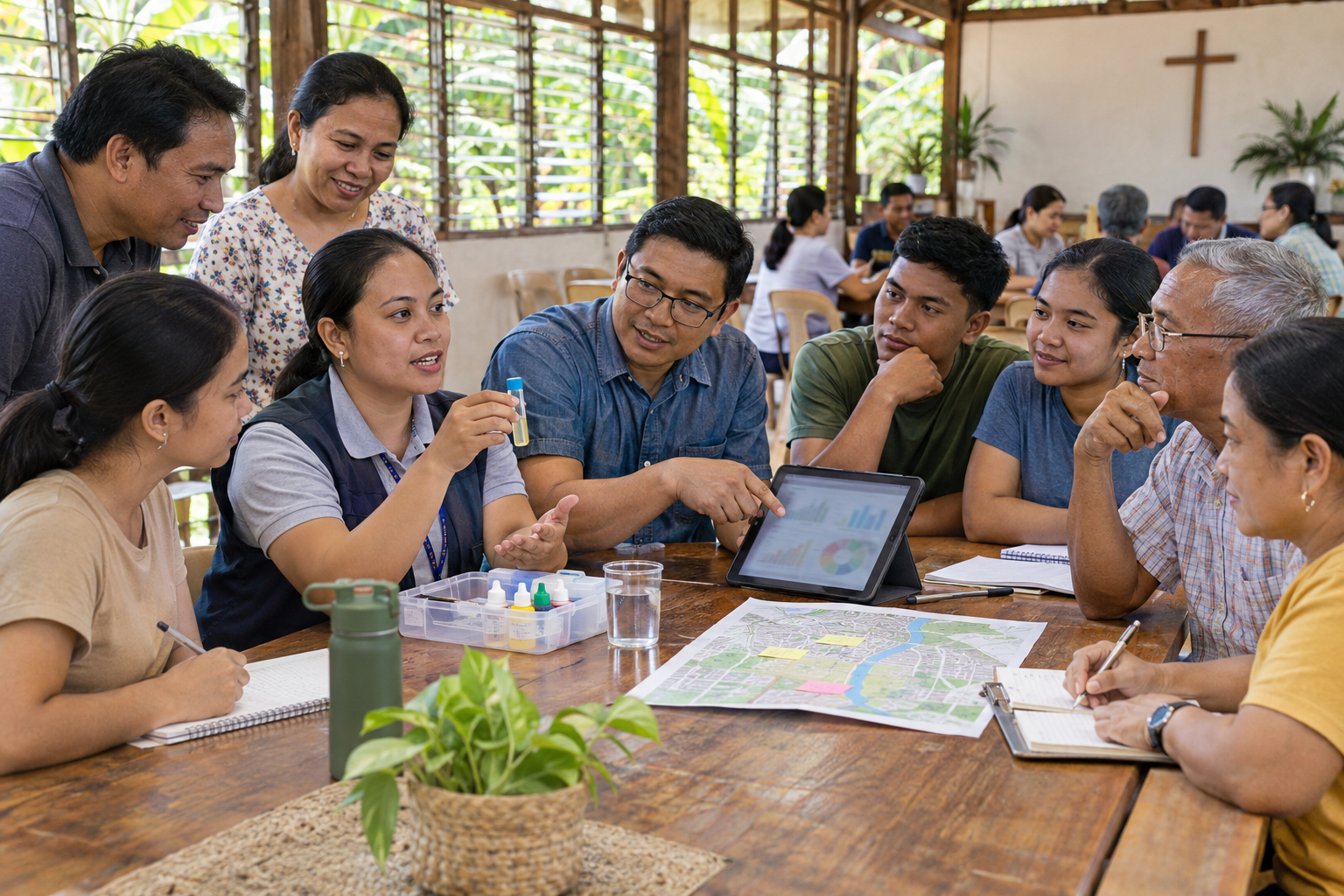
A church does not need to become a laboratory. It needs relationships with people who know the subject. Build a local directory of licensed health workers, teachers, environmental scientists, engineers, veterinarians, agricultural advisers, disaster officers, social workers, journalists, and other professionals. Include members of the congregation, but verify their qualifications and define the limits of their role.
Invite experts to help design a program, not merely bless a decision already made. A water project needs testing, maintenance, and a plan for contamination. A medical outreach needs lawful practice, records, referral, informed consent, medicine safety, infection prevention, and continuity of care. A disaster seminar needs current local hazard information. A livelihood project needs market evidence, not only enthusiasm.
Pay local professionals fairly when a task requires substantial work. Do not assume their contribution should be free because it serves a Christian ministry. Respecting expertise includes respecting time, responsibility, and professional accountability.
Make the church a place for careful questions
Young people in particular are navigating a crowded digital world of confident influencers, artificial intelligence, edited images, anonymous accounts, and algorithmic recommendations. UNESCO’s October 2026 work in Indonesia stressed media and information literacy as protection against misinformation, harmful content, cyberbullying, privacy risks, and other online harms. Earlier in the year, UNESCO and Indonesia’s Ministry of Religious Affairs also committed to integrating media and information literacy in faith-based schools.
Church youth programs can teach simple habits: pause before sharing, read beyond the headline, check the date and location, search for the original source, compare reliable outlets, examine whether an image is reused, and ask what evidence would change one’s mind. Leaders should model those habits when preparing sermons and presentations. A moving illustration found online should not be presented as a fact without verification.
Teach that asking a sincere question is not rebellion. A young person should be able to say, “I do not understand,” or, “What is the evidence?” without being shamed. Leaders can answer, “I do not know; let us find out.” That sentence may build more trust than an impressive but invented response.
Use evidence in disaster and climate ministry
Southeast Asia faces typhoons, floods, earthquakes, tsunamis, haze, heat, drought, landslides, and volcanic hazards. During an emergency, old photos, fake donation appeals, exaggerated forecasts, and unverified casualty numbers can spread quickly. Churches should share warnings from the responsible national and local agencies and include the time, location, and link.
Do not predict a disaster through a dream, private message, or social-media post and present it as an official warning. Spiritual care is valuable during uncertainty, but it must not compete with evacuation instructions or hazard expertise. If a ministry receives information that seems urgent, confirm it with the local disaster office before broadcasting it.
Churches can also contribute local knowledge. With permission, residents can map blocked drains, unsafe crossings, people who need evacuation help, wells affected by saltwater, or areas where alerts are not heard. Local observations become most useful when shared through agreed channels and interpreted with qualified partners.
Protect people in health and healing ministry
Prayer for healing should never depend on refusing appropriate medical care. Ministry leaders should not diagnose, prescribe, alter medication, or promise a cure unless they are authorized professionals acting within their scope. They should never blame a person’s illness on insufficient faith or use a vulnerable moment to pressure a conversion or donation.
When a testimony involves health, obtain informed consent and avoid publishing private details. Do not turn a person into evidence for a treatment or ministry claim. If the church organizes screening or treatment, establish referral pathways for results that require follow-up. A one-day event is not successful if people receive alarming findings and no safe route to care.
Translate information accurately, use familiar terms, and check understanding. A signature on a form does not prove informed consent if the person could not read it or felt unable to refuse. Scientific integrity and Christian dignity meet in the same question: did this person understand, choose freely, and receive truthful care?
Measure whether a program helps
Mission reports often count activity: meals served, meetings held, Bibles distributed, consultations completed, or people who raised a hand. Those numbers may be useful, but they do not automatically show lasting benefit. A church should ask what changed, for whom, for how long, and whether anyone was unintentionally excluded or harmed.
Keep measurement proportionate. A small reading program might track attendance, child safeguarding incidents, reading progress, parent feedback, and school referral. A livelihood program might track completion, income stability, debt, market access, and whether women control the earnings they generate. Collect only the personal data needed, explain why it is collected, secure it, and delete it when no longer required.
Invite participants to interpret the results. Numbers without community explanation can mislead. If attendance fell, the reason may be transport cost, harvest season, safety concerns, caregiving, or a schedule chosen by outsiders. Evidence should help ministries listen and improve, not turn people into a fundraising chart.
Let shared problems become common ground
UNESCO’s 2026 theme describes science diplomacy as a way to find common ground. At community level, cooperation around clean water, mosquito control, maternal health, safer schools, coastal protection, or food security can bring together people who disagree on many other matters. Churches can offer space, volunteers, translation, hospitality, and relationships while technical partners guide the evidence.
Such work must not erase differences or become hidden proselytism. A Muslim, Buddhist, Hindu, Indigenous, or nonreligious neighbor should be able to join a safety workshop without religious pressure. Service is not a bait-and-switch. Christians can be open about their motivation while protecting every participant’s freedom and dignity.
Peace grows when people discover that they can solve a real problem together. A shared water test, community garden, heat plan, or disaster drill may not settle every disagreement, but it can create habits of listening, accuracy, cooperation, and mutual responsibility.
Build a simple truth-and-trust practice
Every church can begin with five commitments. First, verify before sharing. Second, name the source and date. Third, separate testimony, opinion, and evidence. Fourth, involve qualified local people. Fifth, correct errors quickly and clearly.
Assign a small review team for high-risk messages involving health, safety, children, finance, conflict, or public accusations. Create a list of official local sources. Train staff and volunteers in privacy, consent, media literacy, and responsible use of artificial intelligence. Require human review of AI-generated facts, translations, images, and recommendations.
Finally, practice intellectual hospitality. Welcome questions. Refuse mockery. Admit uncertainty. Change course when better evidence appears. These are not signs that a ministry lacks conviction. They are signs that truth matters more than appearing infallible.
Faithful witness in an age of noise
Science and faith answer some different questions, but both require humility before reality. Christians believe that truth is not an enemy to be feared. That conviction should make churches unusually careful with facts, unusually quick to repent of falsehood, and unusually willing to serve alongside people whose expertise can protect a neighbor.
During this International Week of Science and Peace, churches across Southeast Asia can choose a quieter form of courage: refusing the sensational claim, checking the source, listening to the worried parent, inviting the local expert, measuring the result, and correcting the record. These small practices rebuild the trust on which community peace depends.
Further reading: the United Nations’ observance of the International Week of Science and Peace; UNESCO’s World Science Day for Peace and Development; ASEAN’s overview of its Science, Technology, and Innovation agenda; WHO’s 2026 report on the Philippines’ health information environment; and UNESCO’s work on media literacy in Indonesian faith-based schools.
Serve with truth and humility
Ask SendUsAll about locally led mission preparation, responsible partnership, and practical service in the Philippines.
Contact SendUsAll